Tags: stats, language, weird_questions 2nd Feb 2023
Acronymic Groups (Part 2)
This second post will look at the general case where we are looking at words beside BERMUDA, showing the code for that (where interesting) and looking at the results when we plug in a dictionary.
For an English wordlist I ended up using this word list, of about 50,000 words and which contains far less obscure words than other word-lists.
Results
With a word-list and the calculated FLDs we can calculate real probabilities for every word and every scenario, those being with and without order, and with and without choices. We begin by looking at Scenario 1.
I calculate the probabilities, written as prob, by simply going through each letter in a word, and multiplying by its probability in the given FLD.
Here are the top 20 most likely words, using the unisex FLD. The unfortunate result is that the most probable are boring 2 letter words.
word      prob  normalised
  am  0.009912    0.099558
  as  0.007465    0.086401
  me  0.006445    0.080281
  em  0.006445    0.080281
  ms  0.005599    0.074825
  ah  0.005459    0.073884
  ha  0.005459    0.073884
  at  0.004511    0.067167
  mr  0.004327    0.065782
  re  0.003752    0.061251
  he  0.003550    0.059578
  eh  0.003550    0.059578
  an  0.002900    0.053854
  im  0.002481    0.049808
  be  0.002474    0.049737
  pa  0.002036    0.045124
  ne  0.001886    0.043427
  so  0.001872    0.043268
  is  0.001869    0.043226
  eg  0.001860    0.043129
This ‘Normalised’ metric is not actually a normalised probability but is equal to \(\sqrt[n]{prob}\) which will give a sense of which words are most likely whilst allowing longer words to rank equal to shorter words.
Poisson: calculates the probability based on the assumption that the average number of exs is 5 using a poisson distribution, so this may represent a more realistic scenario than prob which suggest the probability of having 1 ex is the same as 5.
And if we sort by normalised it gets a tad bit more interesting.
both:                                   |     women:                              |           men:

   word    prob  normalised  poisson    |    word    prob  normalised  poisson    |    word    prob   normalised  poisson
    ala  9.974e-4    0.0999  1.400e-4   |     ala  0.001435    0.1127  2.014e-4   |     jam  1.089e-3    0.1028  1.528e-4
     am  9.911e-3    0.0995  8.348e-4   |    mama  0.000151    0.1108  2.652e-5   |    ajar  7.907e-5    0.0943  1.387e-5
   mama  9.824e-5    0.0995  1.723e-5   |      am  0.012294    0.1108  1.035e-3   |     raj  7.934e-4    0.0925  1.113e-4
   lama  8.600e-5    0.0963  1.509e-5   |    lama  0.000135    0.1078  2.376e-5   |     jar  7.934e-4    0.0925  1.113e-4
    jam  8.913e-4    0.0962  1.251e-4   |    ease  0.000130    0.1067  2.282e-5   |      am  7.779e-3    0.0882  6.552e-4
 salaam  6.420e-7    0.0928  9.387e-8   |     lea  0.001213    0.1066  1.702e-4   |    mama  6.051e-5    0.0882  1.061e-5
 mammal  6.393e-7    0.0928  9.348e-8   |     ale  0.001213    0.1066  1.702e-4   |     ala  6.591e-4    0.0870  9.253e-5
  llama  6.490e-6    0.0917  1.138e-6   |  salaam  0.000001    0.1064  2.126e-7   |    jarl  5.265e-5    0.0851  9.238e-6
  mamas  6.379e-6    0.0914  1.119e-6   |     sea  0.001182    0.1057  1.658e-4   |    jams  5.168e-5    0.0847  9.069e-6
    lam  7.480e-4    0.0907  1.050e-4   |   mamas  0.000012    0.1044  2.185e-6   |    lama  5.145e-5    0.0846  9.028e-6
   alas  6.477e-5    0.0897  1.136e-5   |    alas  0.000118    0.1042  2.075e-5   |   rajah  4.155e-6    0.0838  7.290e-7
  lamas  5.584e-6    0.0890  9.799e-7   |      as  0.010734    0.1036  9.041e-4   |     jab  5.814e-4    0.0834  8.162e-5
mammals  4.151e-8    0.0881  4.336e-9   |    male  0.000114    0.1034  2.008e-5   |  mammal  3.134e-7    0.0824  4.583e-8
   ajar  5.964e-5    0.0878  1.046e-5   |    meal  0.000114    0.1034  2.008e-5   |    jamb  4.538e-5    0.0820  7.963e-6
   jams  5.788e-5    0.0872  1.015e-5   |    lame  0.000114    0.1034  2.008e-5   |    mara  4.409e-5    0.0814  7.736e-6
alabama  3.761e-8    0.0869  3.928e-9   |  mammal  0.000001    0.1031  1.764e-7   |   llama  3.414e-6    0.0806  5.991e-7
   mara  5.718e-5    0.0869  1.003e-5   |    seam  0.000112    0.1027  1.957e-5   |     aha  5.219e-4    0.0805  7.326e-5
    all  6.548e-4    0.0868  9.192e-5   |    same  0.000112    0.1027  1.957e-5   |     lam  5.162e-4    0.0802  7.246e-5
   mall  5.646e-5    0.0866  9.907e-6   |   llama  0.000011    0.1027  2.010e-6   | alabama  2.129e-8    0.0801  2.224e-9
 llamas  4.215e-7    0.0865  6.163e-8   |   lamas  0.000011    0.1022  1.958e-6   |     cam  4.995e-4    0.0793  7.012e-5
Most probable words
The following two tables show the top 20 most probable words grouped by word size. These values have been calculated by the combined unisex FLDs. Gendered results are in the next section. Each table also includes total_prob which is the total summed probabilities over all words of word length K. N is the total number of words we have of length K. in the vocabulary.
2-word    prob      3-word      prob         4-word      prob       5-word      prob
    am  0.009912       ala  0.000997           mama  0.000098        llama  0.000006
    as  0.007465       jam  0.000891           lama  0.000086        mamas  0.000006
    me  0.006445       lam  0.000748           alas  0.000065        lamas  0.000006
    em  0.006445       all  0.000655           ajar  0.000060        lemma  0.000005
    ms  0.005599       lea  0.000649           jams  0.000058        amass  0.000005
    ha  0.005459       ale  0.000649           mara  0.000057        james  0.000004
    ah  0.005459       sam  0.000644           mall  0.000056        alarm  0.000004
    at  0.004511       mas  0.000644           lame  0.000056        salsa  0.000004
    mr  0.004327       aha  0.000628           male  0.000056        areal  0.000004
    re  0.003752       cam  0.000623           meal  0.000056        small  0.000004
    eh  0.003550       mac  0.000623           area  0.000050        malls  0.000004
    he  0.003550       las  0.000563           elal  0.000049        meals  0.000004
    an  0.002900       sea  0.000558           slam  0.000049        males  0.000004
    im  0.002481       ace  0.000540           alms  0.000049        salem  0.000004
    be  0.002474       raj  0.000519           seam  0.000048        camel  0.000004
    pa  0.002036       jar  0.000519           same  0.000048        madam  0.000003
    ne  0.001886       ram  0.000497           clam  0.000047        malta  0.000003
    so  0.001872       arm  0.000497           calm  0.000047        mamba  0.000003
    is  0.001869       mar  0.000497           mace  0.000047        areas  0.000003
    eg  0.001860       elm  0.000486           came  0.000047        slams  0.000003

total_prob = 0.1036    total_prob = 0.05914    total_prob = 0.01355   total_prob = 0.001317
N = 47                 N = 589                 N = 2294               N = 4266
 6-word      prob         7-word      prob           8-word     prob
 salaam  6.420e-7        mammals  4.151e-8         mammalia  2.114e-9
 mammal  6.393e-7        alabama  3.761e-8         caracals  1.475e-9
 llamas  4.215e-7        marsala  3.222e-8         amalgams  1.377e-9
 lemmas  3.130e-7        mascara  2.682e-8         caramels  1.316e-9
 alaska  2.810e-7        amasses  2.332e-8         seamless  1.144e-9
 alarms  2.802e-7        caracal  2.271e-8         massacre  1.132e-9
 allele  2.761e-7        jamaica  2.129e-8         malarial  1.077e-9
 camera  2.685e-7        amalgam  2.121e-8         alacarte  1.060e-9
 madame  2.547e-7        mahatma  2.104e-8         almanacs  1.017e-9
 smalls  2.380e-7        caramel  2.027e-8         massless  9.943e-10
 sahara  2.351e-7        cascara  1.954e-8         sarcasms  9.839e-10
 sesame  2.335e-7        alleles  1.793e-8         saleable  9.040e-10
 camels  2.281e-7        measles  1.762e-8         escalate  8.924e-10
 armada  2.280e-7        cameras  1.744e-8         callable  8.831e-10
 madams  2.212e-7        almanac  1.567e-8         marshals  8.642e-10
 jackal  2.127e-7        sarcasm  1.515e-8         teammate  8.454e-10
 mambas  2.111e-7        armadas  1.480e-8         carcases  8.253e-10
 pajama  2.086e-7        malaria  1.427e-8         escalade  7.887e-10
 leases  2.044e-7        lacteal  1.387e-8         releases  7.670e-10
 easels  2.044e-7        academe  1.387e-8         scalable  7.598e-10

total_prob = 0.0001057   total_prob = 6.781e-6     total_prob = 3.3527e-7
N = 6936                 N = 9203                  N = 9396
Boy results and girl results
Gendered results can be found here: Gendered results
Scenario 2
To calculate the probabilities, we calculate the number of permutations of the letter in the word using the multinomial coefficient formula for each word and multiply that by the probabilities in Scenario 1. The result tables can be found here: Gendered results
Scenario 3
The following code solves scenario 3, which can be thought of scenario 1 - except at each stage we must calculate the probability of not getting letter \(L\) from \(K\) choices which we do with a simple binomial.
def scenario3(fld, word, k):
    word = word.upper()
    prob = 1
    for letter in word:
        p =fld[ord(letter)-65]
        prob *= 1-pow(1-p, k)
    return prob

values = list(range(1,11))+[15, 20, 30, 40, 50, 100, 500]
fld = [1/26 for _ in range(26)]
word = "bermuda"
for k in values:
    answer = scenario3(unisex_fld, word, k)
    print(f"{k: 5d} {answer:.4g}")
It seems for most values of K, the most probable values are roughly all the same up to some large value of K value, and so I will omit dumping too much data here. You can confirm that by looking at the results for word length 5 results, that shows the consistent ordering. And when K=1 (a single choice per letter) this reduces to scenario 1 - so you can refer to the data there to see what is most likely for any word, and any small K value you might be interested in.
Scenario 4
The code use here is similar to the version from the previous post but generalised to work for any word, and it has been optimised to use memoisation.
@lru_cache(maxsize=None)
def solution(state, k, fld):
    current_state = list(state)
    if all(x == 0 for x in current_state):
        return 1.0
    total = 0
    cur = 1
    for i in range(len(current_state)):
        if current_state[i] > 0:
            branch_prob = 1-pow(1-fld[i], k)
            current_state[i] -= 1
            total += cur * branch_prob * solution(tuple(current_state), k, fld)
            current_state[i] += 1
            if k > 1:
                cur *= (1-branch_prob)
    return total

# Acronym group case 4 generic case
def presolution(fld, word, k):
    word = word.upper()

    letter_freq = [0 for _ in range(26)]
    for i in word:
        letter_freq[ord(i)-65] += 1

    sorted_freq = sorted(zip(letter_freq, fld), key=lambda x: x[1] )
    sorted_state = [x[0] for x in sorted_freq]
    sorted_fld  = sorted(fld)

    return solution(sorted_state, k, sorted_fld)


values = list(range(1,11))+[15, 20, 30, 40, 50, 100, 500]
unisex_fld = [0.11496, 0.03309, 0.06283, 0.03468, 0.07475, 0.02670, 0.02488, 0.04748, 0.02877, 0.08992, 0.03774, 0.07547, 0.08621, 0.02522, 0.02882, 0.01771, 0.00054, 0.05018, 0.06493, 0.03924, 0.00134, 0.00536, 0.01096, 0.00071, 0.00419, 0.01318]

word = "bermuda"
for k in values:
    answer = presolution(unisex_fld, word, k)
    print(f"{k: 5d} {answer:.4g}")
Using the code, with some changes I have done a search of the most probable words over K = [2,5,10] and word lengths from 3 to 9. The results are here. Interesting enough the most probable 5-letter word, using the same FLD is in fact my name: James.
One aspect not yet addressed (but briefly mentioned above) is the conditional probability distribution of group sizes ( the chance of Lee Mack having exactly seven exes’) which would be actually relevant if trying to figure out if Lee Mack’ is lying. However I will leave this as an exercise to the reader.
Addendum
- Original link of wordlist: http://www.mieliestronk.com/wordlist.html
- Copy of the wordlist on my github.
- Full code
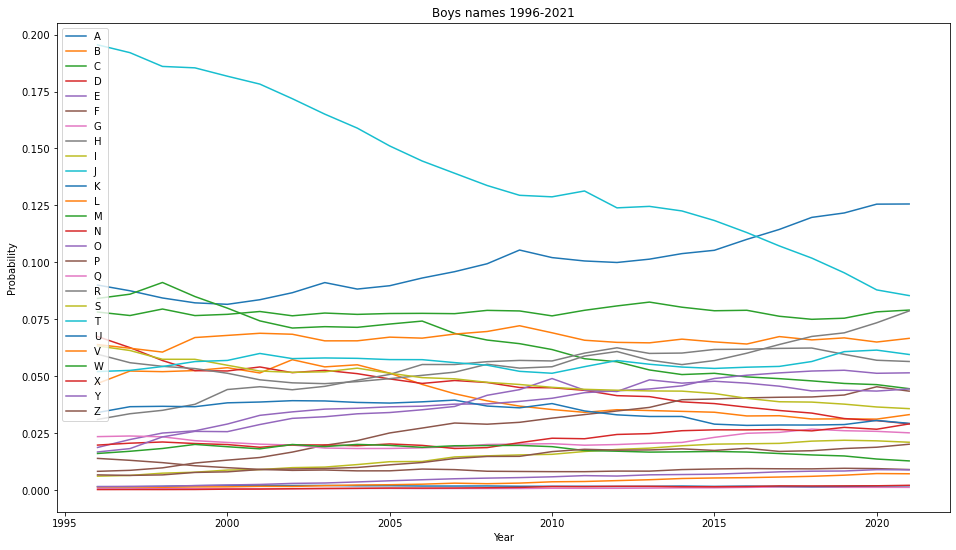
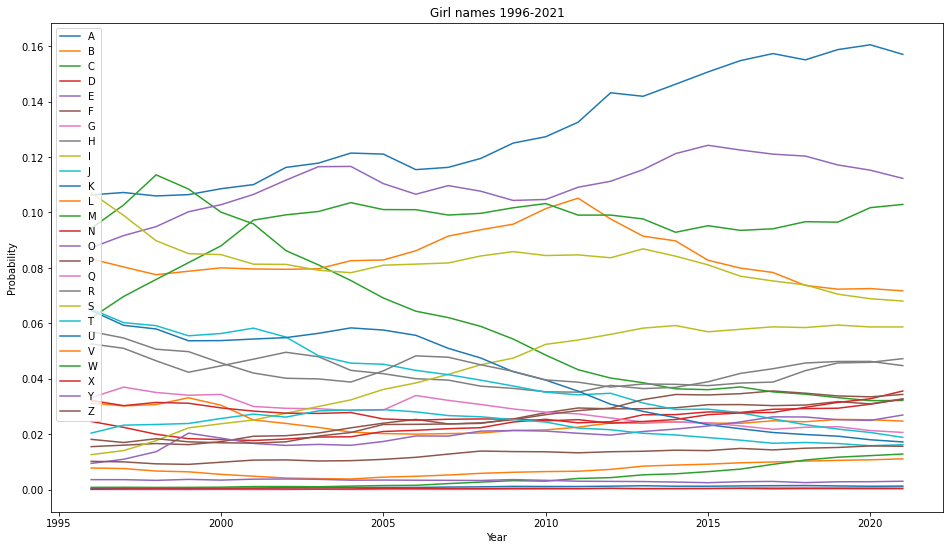
Here are the changes of the FLDs for boy and girl names from the year 1996-2021, using the census data.